Blue Arbor Technologies announced a partnership with Ottobock, anchored by a $5 million investment.
The investment positions Ottobock — also the leading shareholder in Onward an investor in Phantom Neuro — as the lead investor in Blue Arbor’s Series A financing.
Related: Nyxoah invests in further expanding its Belgian manufacturing capacity
Ottobock is a leader in prosthetics, neuro-orthotics and wearable human bionics. As a major investor with a seat on Blue Arbor’s board, Ottobock partnered with the company to deliver advances in upper- and lower-limb prosthetics.
Blue Arbor develops its flagship RESTORE (Reimagining Engineering Solutions To Optimize Restoration of Extremities) neuromuscular interface system. The first-of-its-kind system directly connects advanced prostheses to a patient’s residual muscles and peripheral nerves. Blue Arbor designed it to enable independent and simultaneous control of the fingers, wrist and elbow.
The company said the investment from Ottobock builds significant momentum. It aims to move into the next phase of clinical validation, product development and commercial readiness of RESTORE.
“Blue Arbor’s neuromuscular interface represents a highly promising innovation for the next technological leap in prosthetic control — one that aligns perfectly with our mission to enhance human mobility through meaningful innovation,” said Oliver Jakobi, CEO of Ottobock. “We were impressed by their first-in-human case at the Medical University of Vienna and are excited to partner with them as they move into clinical trials.”
Grass Lake, Michigan-based Blue Arbor designed RESTORE to integrate into the peripheral nervous system with available robotic prosthetics. It aims to restore naturalistic hand and arm function in patients with upper limb loss. The platform could enable patients to move upper limb prosthetic devices with improved dexterity, speed and reliability.
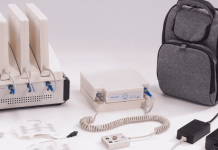
Unlike conventional prosthetic approaches, the system aims to provide a direct link between to muscles connected to nerves. Signal processing takes place through a wireless sensing unit to enable simultaneous, multi-degree-of-freedom movement commands for commercially available robotic prosthesis.
RESTORE has FDA breakthrough device designation. It was also accepted into the FDA’s Total Product Life Cycle (TPLC) Advisory Program (TAP) Pilot. In early feasibility studies, Blue Arbor reports stable, high-quality motor signal capture for more than five years.
In December 2025, surgeons at the Medical University of Vienna implanted the first patient with the RESTORE external sensing unit. They implanted electrodes into multiple targeted muscle reinnervation sites. According the company, within days, the patient demonstrated functional use of the system with a state-of-the-art Ottobock prosthetic.
“The RESTORE ystem is about restoring intuitive, volitional movement – not asking patients to adapt to technology, but designing technology that adapts to human biology,” said Tod Borton, CEO of Blue Arbor Technologies. “Ottobock’s investment and strategic partnership validate the transformative potential of this platform and position us to move faster toward broad clinical impact.”